



Ford Utilizing Car Parks for Solar Power Initiative
Ford is steadfast in its mission to create a more sustainable, inclusive, and equitable future for transportation. The company has set an ambitious target to source 100% carbon-free electricity for its global manufacturing operations by 2035. Ford has already made significant strides toward this goal, achieving 70.5% carbon-free electricity in its global manufacturing processes in 2023.
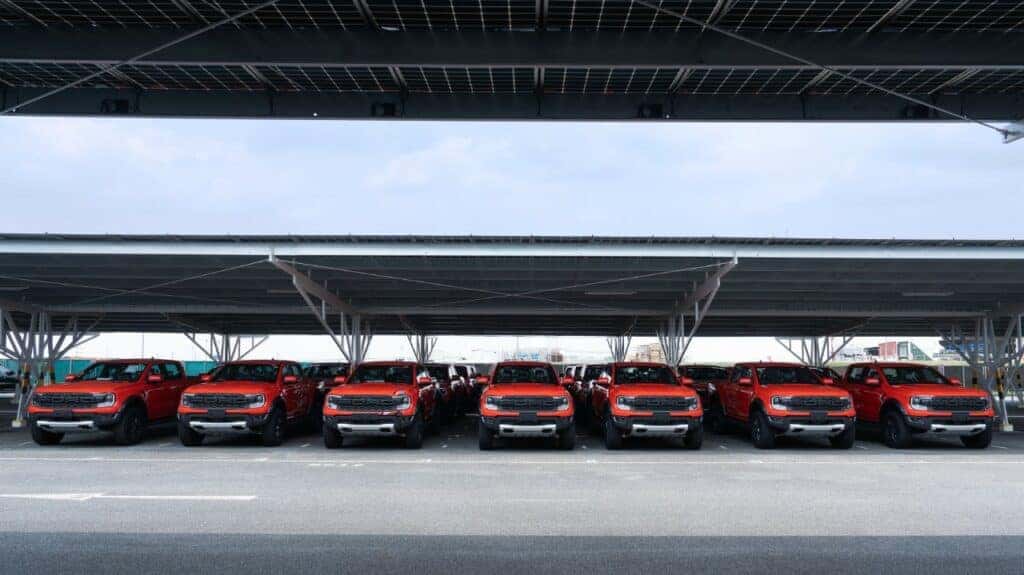
In key production facilities for the Ranger and Everest models located in South Africa and Thailand, solar power plays a crucial role in helping Ford achieve its sustainability objectives. Notably, Ford has established the largest solar canopy carparks in Africa at the Silverton Assembly Plant and in Thailand at Ford Thailand Manufacturing.
Andrea Cavallaro, Ford’s Director of Operations for the International Market Group, emphasized the potential of these solar canopy carparks, stating, “Solar canopy carparks are an incredibly exciting opportunity for Ford as they allow us to make use of spaces that would otherwise have limited use.”
Cavallaro elaborated on the benefits of these photovoltaic systems, highlighting that car parks offer immense potential for converting solar energy into electricity. He explained, “The advantage is that they provide shelter for finished vehicles from the rain and excessive heat while also providing power for nearby facilities.”
At Ford’s Silverton Assembly Plant in Pretoria, a 13.5-megawatt solar carport was completed in 2022. This impressive installation, with parking for more than 3,500 vehicles, now supplies 18% of the electricity required to produce each Ranger. This renewable energy source enables the production of over 20,800 Rangers annually using solar power.
Similarly, Ford Thailand Manufacturing (FTM) recently activated a 7.7-megawatt solar carport, offering shelter for more than 1,500 vehicles. This solar roof significantly contributes to reducing carbon dioxide (CO2) emissions by more than 5,700 tons annually. The solar carport at FTM provides up to 20% of the energy needed for manufacturing each Ranger and Ranger Raptor, enabling the production of around 21,000 vehicles per year solely with solar energy.
Auto Alliance Thailand has unveiled plans to construct an 8-megawatt floating solar energy array near its Rayong facility. Scheduled to go online in September, this project is expected to offset more than 5,400 tons of CO2 emissions annually. This floating solar farm will supplement the existing 6-megawatt solar project at the plant, making Auto Alliance Thailand Ford’s largest solar energy user in the region with a total of 14 megawatts.
“At Ford, we’re focused on environmental quality; both in terms of what we build and how we build,” Cavallaro said. “We’ve continued to push ourselves to conserve water, reduce waste, and transition to carbon-free electricity in manufacturing. Initiatives like solar canopy carparks and floating solar farms are an incredibly vital part of our Road to Better commitment, which helps build a more sustainable, inclusive and equitable transportation future.”
Cavallaro emphasized the importance of these systems in contributing to Ford’s production needs while reducing dependence on fossil fuels. He stated, “That these systems can make use of otherwise inert space and contribute in a very real way to our production needs, while reducing our reliance on fossil fuels for energy, is an important contribution in our ongoing ambition to help build a better world.”
Ford’s commitment to sustainability is evident in its innovative use of solar power across its global manufacturing facilities. By utilizing solar canopy carparks and floating solar farms, Ford is not only reducing its carbon footprint but also making significant strides towards a greener and more sustainable future. These efforts align with the company’s broader goals of environmental conservation and responsible manufacturing practices.
As Ford continues on its path toward sustainability, it serves as a model for other companies in the automotive industry. By prioritizing renewable energy and making strategic investments in solar power, Ford is leading the way in creating a more sustainable transportation future for all.
Want to keep up with all the latest Ford news? Be sure to continue reading our blog here!

0 comment(s) so far on Ford Utilizing Car Parks for Solar Power Initiative